
It’s 24 December and across the world people are celebrating Christmas in one form or another. As at his birth the gospels painted a picture of international reaction. Jewish shepherds, humble folk consistent with the modest situation of the manger birth, are the first visitors and then preachers as they go and spread the word. Later the wealthier wise men, Gentile foreigners, will come to pay homage to the Christ child with rich gifts of gold and precious fragrances. In the sky above Bethlehem the angels appeared to the shepherds (Luke 2:14) declaring goodwill to humanity and peace on earth.
Sadly there is not much unity of Jew and Gentile, not much agreement between rich and poor today. The words goodwill to humanity and peace on earth are frequently expressed and infrequently applied.
Ignoring the minor details of time of year, the overlays of spurious tradition and the gob smacking commercialisation of Christmas today – what does it mean, this birth of a child?
What does Christmas mean?
Well this morning let’s consider the meaning through Mary. What did all of this mean to her? How did she react, what did she see and hear?
Who was Mary?
Mary was a young woman from modest circumstances engaged to a young tradesman called Joseph. Joseph was craftsman of some description (some suggest the term should be understood as a wood worker rather than narrow carpentry[1] others as a general builder with stone[2], Justin Martyr claims Jesus carried on his father’s craft making “ploughs and yokes”[3]). Mary no doubt expected her life to follow a fairly normal path and that she would enjoy a modest lifestyle in Nazareth – poor by modern western standards but closer to lower working class than the day labourers or slaves who formed the bulk to the Roman Empire’s population and the bottom level of society[4]. In Luke 2:24 Joseph and Mary offer the sacrifice of a pair of doves in the Temple which could indicate they were poor except we know the city profiteers inflated the cost of birds by as much as 100 times[5] – so we can’t really tell!
This modest but stable future was upended by the unexpected and unlooked for announcement of the angel Gabriel that she would bear the son of God. Her dreams, her everything were in a second dashed. She would be “that girl” in a small village of sharp tongues and the accusations would follow her and her son into his adult life (eg John 8:41). ‘Her’ Joseph would have cause to reconsider their relationship and but for the intervention of God would have divorced her (Matt 1:19-24).
All of her certainties, all her securities go up in smoke in an instance. Her reaction? ‘I am your slave’ (Luke 1:38), providing her consent to the plan. This contrasts to the righteous old priest Zechariah (Luke 1:6 who struggled to accept the message promise of John’s coming). Mary is not entirely normal – there is something about Mary. God saw it and wanted this young girl to take on a critical part of His plan to save the world. As Bock says in the NIV Application Commentary:
it is hard to appreciate the walk of faith Mary is asked to take here. In the midst of it all, however, what overwhelms her is not the “risk” of appearance, with its potential risk to her reputation, but the joy of serving and being involved with God. We too should have moral integrity and be quick to serve God, even at great risk to our reputation[6]
The coming of Christmas came at great cost for Mary, but that’s just Mary right? Does God ask that of us?
Few of us would think we are like Mary. We have not been asked to abandon our reputations, our livelihood, our entire identities in order to follow the Lord. Or have we? Later in his Gospel, Luke records Jesus’ teaching: “Whoever tries to keep their life will lose it, and whoever loses their life will preserve it” (Luke 17:33). A life abandoned to God in trust should be the pattern for followers of Christ, not the exception.[7]
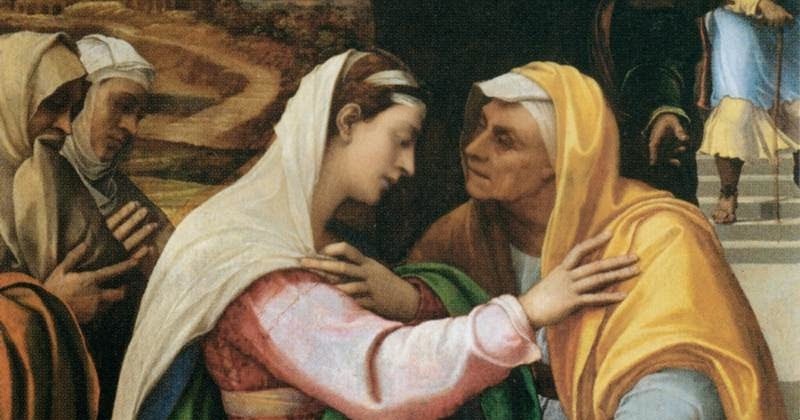
Mary is asked so much. What did this mean to her emotionally? How did she feel? Why is she willing to do this great thing? We get the answer in Luke 1:46- 55, the passage traditionally called the Magnificat. Meeting up with Elizabeth, Mary breaks into a hymn of praise composed extemporaneously. An incredible hymn, spoken by a young Jewish woman from the relatively poor rural village of Nazareth.
Before we go on to consider the way Mary understood the gospel, God’s grand plan of redemption, just pause and consider who she is as revealed by these nine verses. Mary is alluding to and quoting from Genesis, Deuteronomy, 1 Samuel, Job, Psalms, Isaiah, Micah, Habakkuk, Zephaniah. Unbelievable at least nine different books of the Old Testament and there are multiple references to them (eg many different Psalms are alluded to). Mary was soaked in the Bible. And God chose her to bring up His son who was the word made flesh (John 1:14), a characteristic Jesus gained from both his father and his mother. She was soaked in God’s word and had been transformed by it.
Mary was a meditator. We learn this about her when she hears the shepherds report we read
Mary treasured up all these words, pondering in her heart what they might mean
Luke 2:19
And after the events of the first two temple visits when Simeon and Anna react to the baby Jesus and then as a 12 year old Jesus is found in the Temple talking with the religious leaders again we see at the conclusion whole infancy period of Jesus life that
his mother kept all these things in her heart
Luke 2:51
Mary wasn’t a bookish scholar, . She was a thinker, a meditator. Someone who hung onto God’s word and thought about it. She was a young Jewish woman, innocently pregnant out of wedlock, under the thumb of Rome, stuck in a patriarchal society – little wonder the Bible for her was about hope for the downtrodden and oppressed[8]. When Luke wants to open his orderly account of Jesus and show what the gospel means, to impress upon his first reader Theophilus, he records Mary’s speech as setting out the importance and meaning of the gospel.
The speech, song, explosion of joy, it has two main sections, the first is predominantly about her situation and the second expands to a universal perspective.
“My soul exalts the Lord, and my spirit has begun to rejoice in God my Savior,
because he has looked upon the humble state of his servant.
For from now on all generations will call me blessed, because he who is mighty has done great things for me
and holy is his name;
Luke 1:46-49
The verse starts and ends with praise to God in v46 and 49 while the middle section contains and acknowledgment of Mary’s humble lowly state with the reversal that God has changed her position and made her blest.
The second stanza moves to a more global perspective. Now the verse will start and end with God’s faithfulness, particular with reference to the promise to Abraham. In between rather than Mary’s lowly state she now considers the promises as pointing to a wonderful reversal for all people. Of itself this is remarkable – how unselfish was Mary who was facing a difficult time and yet thinks of all the downtrodden in this moment.
from generation to generation he is merciful to those who fear him.
He has demonstrated power with his arm; he has scattered those whose pride wells up from the sheer arrogance of their hearts. He has brought down the mighty from their thrones, and has lifted up those of lowly position;
he has filled the hungry with good things and has sent the rich away empty.
He has helped his servant Israel, remembering his mercy, as he promised to our ancestors, to Abraham and to his descendants forever
Luke 1:50-55
The proud will be brought down from their thrones and the lowly lifted up. The hungry will be satisfied but the rich will feel the disappointment of emptiness. Two radical reversals. Like me you might not have seen the missing third reversal. ‘He has helped his servant Israel’, Israel was under the oppression of Rome. We might have expected the phrase to be followed by ‘and he will crush the Gentiles beneath his feet’ but no[9]…the gospel is not limited to Israel, this is not about national reversal and redemption but rather than the unshackling and lifting up of the poor and hungry no matter their origin.
The gospel is underpinned by the promises to David – introduced by the angel Gabriel – and the promises to Abraham as referenced by Mary. Practically according to Mary the gospel means change. It means a radical reshaping of the world. All families of the earth will be blest. There will be peace on earth and goodwill toward men and women. But. You cannot relieve the oppression of the poor without dealing with the oppressor. To make compassion concrete there must be change. As Bovon observes:
God cannot place his power at the service of his compassion for the humble and weak, without it coming into conflict with that of the mighty of this world.”[10]
As NT Wright says:
Mary and Elisabeth shared a dream. It was the ancient dream of Israel: the dream that one day all that the prophets had said would come true. One day Israel’s God would do what he had said to Israel’s earliest ancestors: all nations would be blessed through Abraham’s family. But for that to happen, the powers that kept the world in slavery had to be toppled. Nobody would normally thank God for blessing if they were poor, hungry, enslaved and miserable. God would have to win a victory over the bullies, the power-brokers, the forces of evil which people like Mary and Elisabeth knew all too well…. Mary and Elisabeth, like so many Jews of their time, searched the scriptures, soaked themselves in the psalms and prophetic writings which spoke of mercy, hope, fulfilment, reversal, revolution, victory over evil, and of God coming to the rescue at last.[11]
What is the gospel? Well according to Mary it is the fulfillment of the Old Testament promises. It is about blessing all families of the earth.
As her son would go on to explain, it is about a new world – operating under the love of God. The poor in spirit who will inherit the kingdom, those who mourn will be comforted, the meek will inherit the earth. The Beatitudes contain many of the reversals implicit in Mary’s heartfelt reaction to the joy of Elizabeth.
The reign of Jesus will see everybody sit under their own vine and fig tree – ie enjoy a measure of security and prosperity, an economic reality far from today’s concentration of wealth. When Jesus is king the law shall go forth from Zion (Isa 2), the seat of Jesus throne ie the rule of law will be consistently applied rather than the rich, the powerful and the white enjoying vastly different outcomes than others. Labourers will no longer see their wages held back deceitfully by landowners (to echo another of Mary’s children – James in James 5). Economic activity will be moderated by love rather than profit being put above people. The Lord – himself an infant refugee – will take up the cause of the homeless, the fatherless and the stateless in the manner of His father, who explicitly provided for such in ancient Israel.
This is the promised reversal Mary longed for. A world of justice and God’s love, long promised by the prophets.
Now you might be thinking ‘that sounds political’. Of course it is! The gospel of Jesus’ kingdom means radical change. Filling the hungry with food and sending the rich away empty is political. Putting people first and caring for the vulnerable is an economic and political choice that a righteous king will make. Removing the powerful from their thrones and elevating the lowly is a direct political hope. It is also an assertion that this world is about as topsy turvy from God’s ways as you can get. We support the future policies of Jesus today.
We know that when the prince of peace reigns this world will change. No longer will we see the abominations of Hamas and suffering of both Jew and Palestinian. The nightmare of Sudan, the aggression of Putin and the oppressive regimes which all but encircle the globe, will be a thing of the past when the child born in a manger takes the throne of his father David.
The gospel means yearning for a different world. One of love. One of peace. A world where Jesus will “make all things new” to echo Rev 21:5. All things new, nothing will be the same.
Jesus will return to sit on the throne of David, to set up God’s kingdom, to fulfil the promises to Abraham and bless all families of the earth.
We come to remember Jesus. We know the gospel. We can’t wait for his return, like Mary we are profoundly distressed by the state of this world and yearn to see change. To see radical transformation in the current order of things. The world celebrates the birth of Jesus and it is a time of family and increased generosity – all of which is good of itself. But it is such a tiny localised realisation of the potent power of Christmas, the transformation which Mary looked for.
Christmas is about the start of something much bigger than a family lunch, nice though that may be. The angels cried aloud in the sky – ‘peace on earth and goodwill to all’. We don’t see it now but we know we will. That is Christmas. That is what God was working to when He sent His angel to speak to this brave, faithful and thoughtful woman. Mary was prepared to partner with God to create the turning point of history and open the way for a radical new world of love, peace and righteousness.
We are invited into the same purpose, the same agenda for change, ie we are invited to embrace the gospel resting as it does on all the Old Testament promises. We are invited to partner with God to participate in His purpose.
May the day be soon when God will remember his mercy, as he promised to Abraham, and there will be peace on earth and goodwill to all. And with this hope, this joy, this gospel, have a Merry Christmas.
by Daniel Edgecombe
[1] Horst Robert Balz and Gerhard Schneider, Exegetical Dictionary of the New Testament (Grand Rapids, Mich.: Eerdmans, 1990–), 342.
[2] Klaus D. Issler, “Exploring The Pervasive References To Work In Jesus’ Parables,” Journal of the Evangelical Theological Society 57 57, no. 2 (2014): 326–327.
[3] Justin Martyr, “Dialogue of Justin with Trypho, a Jew,” in The Apostolic Fathers with Justin Martyr and Irenaeus, ed. Alexander Roberts, James Donaldson, and A. Cleveland Coxe, vol. 1, The Ante-Nicene Fathers (Buffalo, NY: Christian Literature Company, 1885), 244.
[4] John P. Meier, A Marginal Jew, Rethinking the Historical Jesus: Volume One, The Roots of the Problem and the Person (New Haven; London: Yale University Press, 1991), 282.
[5] Joachim Jeremias, Jerusalem in the Time of Jesus: An Investigation into Economic and Social Conditions during the New Testament Period, trans. F. H. Cave, C. H. Cave, and M. E. Dahl (Philadelphia: Fortress Press, 1975), 121–134op
[6] Darrell L. Bock, Luke, The NIV Application Commentary (Grand Rapids, MI: Zondervan Publishing House, 1996), 68.
[7] Aubry Smith, “The Mother: ‘He Who Is Mighty Has Done Great Things for Me’ (Luke 1:26–56),” Bible Study Magazine (Bellingham, WA: Lexham Press; Faithlife, 2018), 25.
[8] Robert Simons, “The Magnificat: Cento, Psalm or Imitatio?,” ed. P. J. Williams, Tyndale Bulletin 60, no. 1 (2008): 43.
[9] Kenneth E. Bailey, Jesus through Middle Eastern Eyes: Cultural Studies in the Gospels (Downers Grove, IL: IVP Academic, 2008), 191–192.
[10] François Bovon and Helmut Koester, Luke 1: A Commentary on the Gospel of Luke 1:1–9:50, Hermeneia—a Critical and Historical Commentary on the Bible (Minneapolis, MN: Fortress Press, 2002), 64–65.
[11] Tom Wright, Luke for Everyone (London: Society for Promoting Christian Knowledge, 2004), 13–16.
 Living Faith