
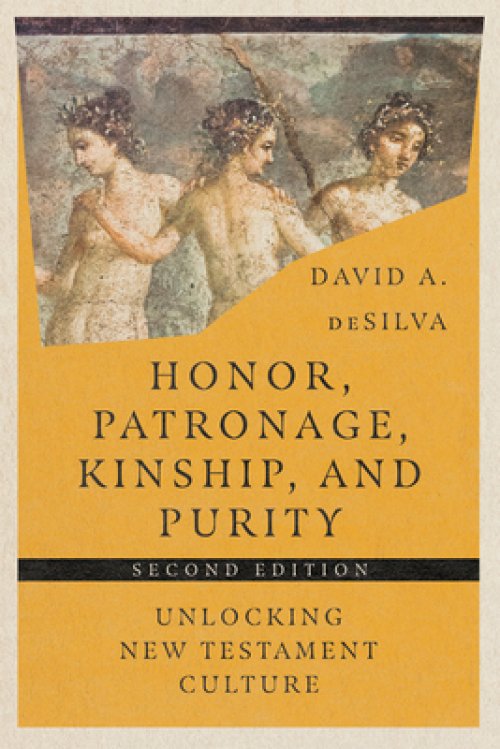
deSilva’s 2012 title “Honor, Patronage, Kinship and Purity: Unlocking New Testament Culture” (published by IVP) is a fantastic read. It traces the meaning of the 4 titular concepts in a Greek, Roman and Jewish context with reference to source material and then explores the concept as it colours the New Testament . deSilva also effectively translates into a Western cultural context to extract practical implications for disciples today.
Dr. David A. deSilva is the Trustees’ Distinguished Professor of New Testament and Greek at Ashland Theological seminary. A Methodist, he has authored over 25 books. In his introduction to this book deSilva highlights the importance of cultural context to accurate Bible reading:
Without taking some care to recover the culture of the first-century Greco-Roman writers and addressees, we will simply read the texts from the perspective of our cultural norms and codes. Negatively, then, this task is essential as a check against our impositions of our own cultural, theological and social contexts onto the text.
The purpose of understanding the cultural contexts is very much about faithfully meeting the text on its terms, seeking to hear what God intended rather than what our cultural expectations and norms would suggest. We
To immerse ourselves in the cultural context of the New Testament authors and hearers is to open ourselves up to hear the New Testament with the fuller resonances it would have had for authors and addressees alike
Honour and Shame
deSilva commences with a consideration of honour and shame. While the words have meaning they don’t resonate way they did in the first century – at least not to modern Westerners. Ours is a society which focuses on individual honour and shame rather than a collective sense that marked the first century.
Honour and shame were a powerful force to maintain social norms and Christians were targets in all segments of the population for shame. Their messiah was crucified – and the gospel reports dwell at least as much on the shame of the event as the physical suffering. Christians themselves rejected most of the social norms which bound people together and defined an honourable life. Shame was a means of coercing the Christians back to the fold. This forms a consistent theme in early writings:
The authors of the New Testament devote much of their attention, therefore, to insulating their congregations from the effects of these shaming techniques, calling the hearers to pursue lasting honor before that court of God whose verdict is eternal. These authors continue to use the language of honor and shame to articulate the value system of the Christian group, and to build up the church into a court of reputation that will reinforce commitment to those values through honoring those who distinguish themselves in acts of love, service and faithful witness and through censuring those who fail to embody those values
In our time a contemporary application is perhaps similarly redefining what constitutes honourable behaviour and rejecting the judgement of society at large in preference to the approval of God and the faithful community.
Patronage & Reciprocity/Grace
This was the best section of the book for me. As I read you realise there is no accident in the structure, the honour culture is the foundation of this next section. To us the idea of patrons and clients is relatively foreign, although influence and relationships still matter today. DeSilva explains the relationship between the parties and the multiple tiers which could exist of patrons and clients.
The way this idea or model of interactions permeated the New Testament quickly became evident. The careful letter to Philemon is the obvious example but by no means the most important. A penny drop moment for me was this observation:
Sometimes the most important gift a patron could give was access to (and influence with) another patron who actually had power over the benefit being sought. For the sake of clarity, a patron who provides access to another patron for his or her client has been called a “broker” (a classical term for this was mediator). Brokerage was commonplace and expected in public life
The mediator role given to Jesus fits well into the patron/client relationship. So too the way that Jesus refers to his disciples as “friends” – the common way patrons politely referred to their clients, albeit the term would never dare be used back the other way. As much as I love the hymn “What a friend we have in Jesus” I think this section of the book just broke the hymn for me forever…
DeSilva demonstrates these relationships were fundamentally transactional, the patron provided goods, access, various favours and for their part the clients did the right thing – they offered public praise of their benefactor. While our relationship with God is not quite so transactional the way the New Testament writers adapt the social practice to model our relationship with God and Jesus jumps out at you as deSilva walks through various passages.
Kinship
deSilva provides extensive information on the formation and operation of families through ancient Greece, Rome and Jewry. Family structures were not homogenous across the cultures – nor even within them. However some common threads are obvious. Family was key to identity, and the ultimate safety net. Siblings ideally would co-operate not compete and the success of one was the success of all. To leave family was almost unthinkable. Yet this is what Christians were called to.
Consequently from Jesus onwards we read of the church being a new family, brothers, sisters and mothers. Believers one and all are descended from Abraham. Yet there is one key relationship which is raised as the model:
Of all the possible family relationships from which to choose, however, it is the sibling relationship that emerges as prominent. Philadelphia (“the love of brothers and sisters”) becomes the central topic for shaping relationships with one another in the church. Believers are often specifically exhorted to embody this particular species of love toward one another
Believers enjoy freedom in Christ, but this freedom is the freedom to walk always with an eye on the betterment of their spiritual siblings.
Let each of you look not only to his own interests but also to the interests of others
Philippians 2:4 ESV
Being in a new family has specific responsibilities aligned with the cultural expectations. Harmony. A lack of competition. Sharing resources. And unity. Having explored much of the demands of this ethic of family deSilva makes the following observation about the one mindedness of Philippians 2
We have too long and too often taken the words “be of the same mind” to mean, functionally, “if you agree with me on these points of doctrine, then we can be sisters and brothers, have fellowship and experience God together.” As Paul has structured Philippians 2:1–4, the experience of God is primary: since you have received encouragement from Christ, since you have shared in the one Spirit of God, live in full accord with one another, being of one mind. We are prone to be disputatious and to place victory in theological debates higher than the bond of unity. This is not Paul’s way except in issues that truly cut to the core of being Christian (and most issues, let us be honest, do not). Rather than seek to “have it our way” in terms of every dispute, we again find an opportunity for laying down our lives, or at least our egos, for our sisters and brothers as we put love, peace and unity with one another ahead of being right all the time. Paul makes it clear that no one has all the facts (1 Cor 13:12–13 is strong and necessary medicine for our conceited race), and therefore disagreements are not ultimate. Our agreement—our common experience of God through the Spirit—is of greater importance than our disagreement based on finer points of theology, liturgical practice and interpretation. Our agreement is founded on God’s act on our behalf; our disagreements on our own thoughts, minds and hearts. To place greater importance on the latter than the former is an act of pride, of hybris, an affront to God. To be “like-minded” is not to agree on everything; it is to put foremost in our minds what is central and common to the believing community in every place, what makes for building up the church of God in the bond of love.
Purity
Purity is not so much a thing we worry about today – at least says deSilva not on the surface. The idea of things being taboo, of there being serious consequences should things be out of place, should things profane the holy is not something with which we identify.
And yet we do have our own deep-seated biases and expectations, our sense when something is out of place and the reaction it provokes. Soil in the garden good, soil in the house immediate action required to correct.
deSilva walks through some of the deep-seated purity concerns of the current cultures. The concept is not without value today. God should be honoured and respected. Disciples were not called to a free for all and the community did develop new boundaries. However the love of Christ required them to redefine many of their old purity laws. The inclusion of Gentiles was a particularly challenging redrawing of the lines for Jewish believers. In this deSilva finds a connection to our modern prejudices:
I ceased to despise the Pharisees’ lack of compassion long ago (or, rather, I came to see how much I had in common with them), when I was confronted with my own purity codes and the separateness from other classes of people I was conditioned from birth to observe
Conclusion
deSilva’s book is packed with information and insights which I found fantastic. But he doesn’t fail to also translated across time somewhat to land some practical punches on what these concepts might mean for us now:
believers would need to measure their own worth and seek honor in terms of the values taught by Jesus and the Spirit
Because of the prominence of patronage and benefaction in the ancient world and the widespread awareness of the obligations owed to generous people, the early Christian had a powerful resource for achieving integrity of faith and life that would greatly benefit us today to recover. That resource is the central and centering focus on gratitude
We are thereby challenged to extend the intimacy, mutual commitment and mutual support of natural family to the family related by the blood of Jesus
it falls to us to set aside the lines learned from our society and our particular upbringing so as not to divide what God joins together. This new community from every race, class, nation and background, however, is still called to holiness—a holiness that we honor and preserve as we cleanse ourselves from the defilements of sin and our churches from the defilements of division
At 319 pages this is not a quick read and at times the amount of cultural context can feel overwhelming. However deSilva is a great writer. The way he brings out his themes from the New Testament is compelling but the real win is how he translates that to meaning for the disciple today.
by Daniel Edgecombe
 Living Faith