
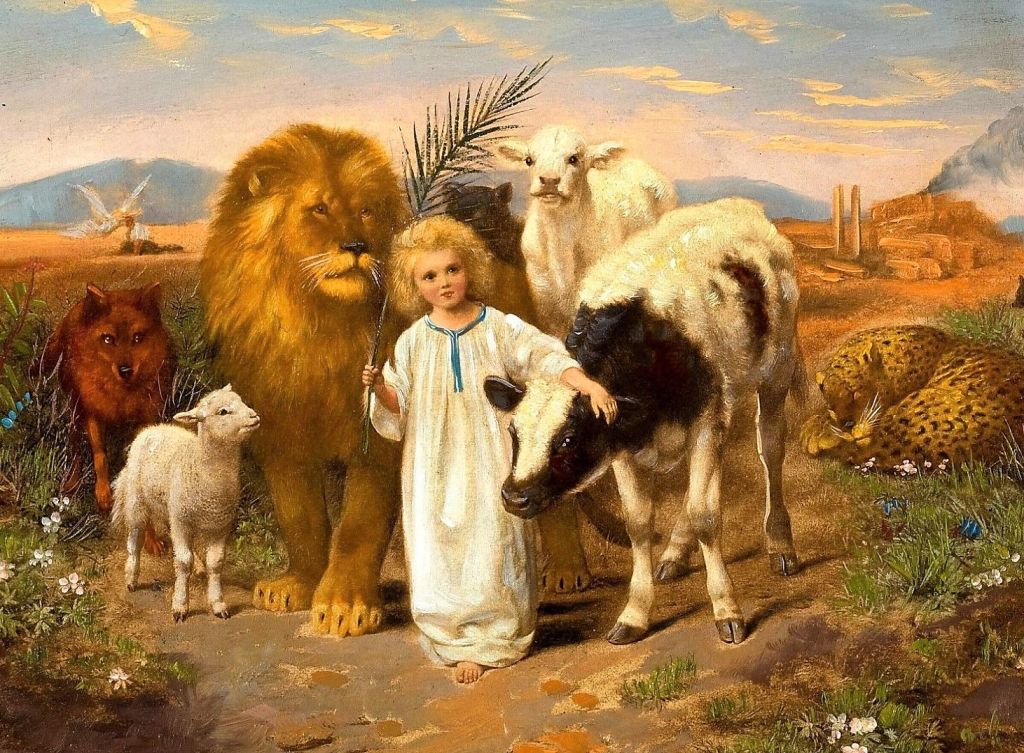
Isaiah 11:6-9 is a popular passage often understood as envisioning a time of peace and security under divine rule. This imagery is commonly interpreted as a literal transformation of animal behaviour. However it is more likely a metaphorical representation of harmony and safety, particularly for the people of God.
The verses read:
A wolf will reside with a lamb, and a leopard will lie down with a young goat; an ox and a young lion will graze together, as a small child leads them along. 7 A cow and a bear will graze together, their young will lie down together. A lion, like an ox, will eat straw. 8 A baby will play over the hole of a snake; over the nest of a serpent an infant will put his hand. 9 They will no longer injure or destroy on my entire royal mountain. For there will be universal submission to the Lord’s sovereignty, just as the waters completely cover the sea. Isa 11:6-9 NET
The context is agricultural village life
The imagery revolves around animals that were either domesticated or threats to the villagers in ancient Israel, like wolves, lions, and snakes. These creatures posed dangers in the agricultural setting but also represent threats to human livelihood and peace. In Isaiah’s vision these dangerous animals are pictured as peaceful. The threats to daily life are removed or neutralised by God. The imagery is readily over interpreted but as Van Ee notes:
Predatory, carnivorous behavior is not the focus. Also, nowhere is it stated or implied that humans return to a vegetarian diet. Instead, what seems to be described is village life in which flocks and herds are still being kept for all the normal purposes, including meat. The only change for humans is the level of peace and security they experience[1]
We are not dealing with a fundamental retooling of nature where everything and everyone becomes vegetarian. The humans in Isa 11 are maintaining the flocks which are used for meat and clothing material.
A local geography is specified
Isaiah limits the application of the peaceful world to a limited geographic space. Verse 9 says this is on God’s “royal mountain”. This is consistent with other passages which suggest a localised blessing rather than necessarily a global one. For instance, Isaiah 35:9 says no ravenous beasts will be on the holy road. This implies ravenous beasts do indeed still operate but just not in this location. So too with Ezekiel 34:25–26 and Lev 26:6 where danger remains but is controlled in a local context.
Healthy ecosystems need predators to prevent overpopulation, control diseased and stop overgrazing. Predators controlling grazing animals benefit a whole range of other flora and fauna. God established viable ecosystems and it seems unlikely He would undo that work. Rather than having something against predators God is described as intimately involved in providing food for them in Job 38:39-41.
Historical and Comparative Utopian Visions
The ancient Sumerian myth of Enki and Ninhursag was likely written around the first half of the second millennia BC. It is something of a creation myth or origin story. It describes the land of Dilmun (sometimes Dilmun is also called a city) with the following glowing terms:
That place is clean, (that place is bright).
In Dilmun the raven utters no cries,
The ittidu-bird utters not the cry of the ittidu-bird,
The lion kills not,
The wolf snatches not the lamb,
Unknown is the kid-devouring wild dog,
Unknown is the grain-devouring …,
[Unknown] is the … widow,
The bird on high … s not its …,
The dove droops not the head,
The sick-eyed says not “I am sick-eyed,”
The sick-headed (says) not “I am sick-headed,”
Its old woman (says) not “I am an old woman,”
Its old man (says) not “I am an old man,”.[2]
Note the language is very much again about peace between nature and the village.
The language of lions and wolves being at peace with the flocks as above was not limited to origin stories. It was also used poetically of present day benefits. For example in the myth of Enmerka and the Lord of Aratta:
Aratta was a rich land in Iran with gold, silver, and precious stones. Enmerka of Uruk quarreled with the ruler of Aratta. Enmerka sent a message to the ruler of Aratta describing a paradisaical future with no harmful wild animals, no fear or anxiety, and no more enemies, if he submitted to Enmerka[3]
Of course, Isaiah is different in some respects to these stories as these myths often carry different philosophical meanings or are embedded in idealized views of societal peace.
However Isaiah’s words most likely had an initial application relevant to his audience. Frequently Isaiah is speaking of Hezekiah as the promised faithful Davidic ruler blessed by God. Such an application would require the language be understood in a poetic, idealised sense.
Symbolic or Metaphorical Interpretation
It is not uncommon to find suggestion that the language should be understood as more about changes in humanity – controlling the violent. Within my faith tradition some prominent Christadelphians have put this view forward – while allowing the possibility of physical changes in the animals as well.
E.g. CC Walker wrote:
The allusions to the change that is coming over the wild beasts are mostly metaphorical, though not necessarily exclusively so. It would be little or no profit if lions were tamed and men left wild. The lions of Assyria and Babylon destroyed Israel. “The devil as a roaring lion” was active in the apostles’ days. For such lions to “eat straw like the ox” would be for Gentile adversaries to be turned into friends of Israel feeding in the same “green pastures.” This, of course, leaves room for the literal dominion of the saints over the beasts of the earth[4]
R Roberts wrote the first part of a commentary on Isaiah which was later completed by Walker. He reasoned:
But let the questions be asked: How does the knowledge of the Lord bear upon the taming of the wild beasts? And what special reference has the matter to God’s holy mountain? A greater and more interesting development then comes into view, and one which is the subject of description in other Scriptures.
There are human wolves and lions, the subduing of whom is a greater work than taming the wild beasts of the forest. What profit would it be if wolves and lions were tamed and men left wild? It will not be so. Beginning with the Lord’s land, the knowledge of the Lord will, after judgment, transform mankind[5]
They suggest these verses metaphorically represent peace between opposing groups or factions among people, transforming hostile groups (the “wolves” and “lions” in society) into allies within God’s kingdom. This approach can broaden the passage’s meaning to apply to social and moral changes among humanity under divine rule.
Conclusion
Isaiah was not promising a change in the fundamental nature of creation.
His prophecy used imagery likely familiar to the audience of idealised peaceful and productive village life resulting from divine blessings. In the first instance this was expected to be as a result of the reign of Hezekiah.
Looking further forward to the kingdom age and we have a similar picture. Isaiah’s vision anticipates the dangers associated with nature and society will be subdued, allowing humanity to live securely in God’s presence. The primary promise seems to be the security and freedom from fear that will characterize the life of those in God’s holy domain, rather than a global ecological transformation. We are not promised a worldwide end to animal predation and death in the kingdom age. Rather there is a security and peace for God’s people within His rule.
by Daniel Edgecombe
[1] Van Ee, J. J. (2013). Death and the Garden : : An Examination of Original Immortality, Vegetarianism, and Animal Peace in the Hebrew Bible and Mesopotamia. https://escholarship.org/uc/item/0qm3n0mt.
[2] James Bennett Pritchard, ed., The Ancient Near Eastern Texts Relating to the Old Testament , 3rd ed. with Supplement. (Princeton: Princeton University Press, 1969), 38
[3] M. J. A. Horsnell, “Religions of the Biblical World: Assyria and Babylonia,” ed. Geoffrey W. Bromiley, The International Standard Bible Encyclopedia, Revised (Wm. B. Eerdmans, 1979–1988), 94.
[4] Charles Walker, The Christadelphian (The Christadelphians, 1906), 452.
[5] C. C. Walker with Robert Roberts, The Ministry of the Prophets: Isaiah (The Publishing Committee, Christadelphian Old Paths Ecclesia, 1907), 205.

