
Ruth 4 feels different from the chapter before it. Chapter 3 took place in the dark. It is characterised by ambiguity and risk. There is a private encounter in a dubious location. Chapter 4 moves the whole matter into public view. Chapter 3 was integrity demonstrated in the dark and now in chapter 4 we will see hesed done publicly. The darkness is over. The question now is not desire, but decision; not possibility, but public resolution. And that matters because the book of Ruth was never a romance in the modern sense. It is a story about hesed, providence, public righteousness, the reversal of Naomi’s emptiness, and the securing of David’s line through surprising people and faithful choices.
That is why chapter 4 is so satisfying. It does not abandon the great themes already in motion. It gathers them up and resolves them.
God is the master storyteller and in chapter 4 we have the resolution of the disasters that befell Naomi. Chapter 1 and Chapter 4 therefore map to each other as observed by Bush[1] who provided some of these ideas summarised below:
| Chapter 1 | Chapter 4 |
| Ten years of death and disaster in Moab v1-5 | Ten generations of life from Perez to David v 18-22 |
| Naomi loses her babies v5 | Naomi has a baby son v16-17 |
| Three parties debate the future conclude there is no chance of a husband and Orpah turns away v 7-14 | Boaz, the legal assembly and the kinsman debate who will be Ruth’s husband and one turns away v1-8 |
| Ruth commits to Naomi without any future v15-19 | Boaz commits to Ruth and receives a blessing of fruitfulness v9-12 |
| Women of Bethlehem amazed at Naomi’s suffering v19 | Women of Bethlehem rejoice in Naomi’s blessing V14 |
| Naomi is bitter and empty v20-21 | Naomi has a redeemer Obed and Ruth who is better than 7 sons v 15 |
Everything is turned around. While nothing would erase the pain of Naomi’s loss, she is not left empty and hopeless. And Ruth who abandoned any hope of future security and family receives all of this and more – a woman whose contemporaries would think barren would now have a child.
We love happy endings. Why? Because we are basic creatures who want a predictable world that works in line with our values and our timelines. Happy endings are always popular but I’m not convinced they are necessarily that common. There is a saying which Martin Luth King Jnr did much to popularise “the arc of the moral universe is long, but it bends toward justice”. I find it hard sometimes to wait for that justice, all but impossible when your life resembles chapter 1.
So who cares that chapter 4 maps to chapter one? We should. In Isa 25:8 there is a beautiful image of God.
he will swallow up death permanently. The sovereign Lord will wipe away the tears from every face, and remove his people’s disgrace from all the earth. Indeed, the Lord has announced it! At that time they will say, “Look, here is our God! We waited for him and he delivered us. Here is the Lord! We waited for him. Let’s rejoice and celebrate his deliverance!” Isa 25:8-9 NET
Those words are echoed in Revelation 21:4-5
He will wipe away every tear from their eyes, and death will not exist any more—or mourning, or crying, or pain, for the former things have ceased to exist.” And the one seated on the throne said: “Look! I am making all things new!” Then he said to me, “Write it down, because these words are reliable and true
We’ve all seen people cry. People see us cry. But there’s only a few that can and will wipe tears from another’s eyes. It is the action of a loving parent or spouse. It’s an expression of great care and intimacy.
God has a plan and in chapter 4 we see one of those moments when the arc of the more universe arrives, when justice is delivered. God is finally wiping the tears from Naomi’s eyes. God though silent in the book, is shown once again to have been at work in the ordinary details all along. Chapter 4 is the public unveiling of what providence has been quietly doing since chapter 1. And more than that – in running down to David, and in Matthew 1 down to Jesus, the long arc is outlined when all tears for all people will be wiped by a loving God, like a parent comforting a child.
Naomi didn’t have her two baby boys back in her arms. But she had the comfort of new joys and new loves. God had turned her disgrace and her pain around. In the kingdom we do not forget our pains and sorrows. But we will be comforted by God who – and I love these words for their implications at a personal and global level – will make all things new. All things, nothing will remain the same.
These words are reliable and true – this is the promise of God, this is the hope of the kingdom. He works in our lives, not to shield us from pain, not to deliver short term happy ending stories but because the arc of the moral universe is long, it bends toward justice and one day it will arrive and we will experience the tender love and care of our saviour.
Setting the stage for a legal drama (Ruth 4:1-2)
At the direction of the Moabite widow, Boaz springs into action. Naomi had ended chapter 3 with confidence: “the man will not rest until he has taken care of the matter today.” That confidence is justified. Boaz goes straight to the gate and sits there. The city gate in ancient Israel was not merely a doorway in the wall. It was a public civic space: a place of benches, deliberation, witness, judgment, negotiation, and communal memory. In other words, Boaz is not heading for a quiet chat. He is taking the matter to the proper forum, where it can be resolved lawfully, publicly, and cleanly.
The layout of city gates appears to have been somewhat consistent – the below illustration from the AYBC[2] of the Gezer gates – a design common to a number of uncovered cities.
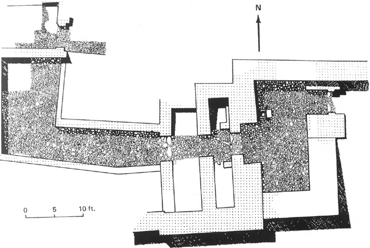
Illustration from the AYBC
The entrance to the city (right of illustration) passed through an area with some open ‘side rooms’ which were possibly meeting places or used for guards (as in the incident at Gaza with Samson in Judges 16:2). Beyond those narrow rooms the arrangement widened out to a plaza on the left of the picture.
Below is a personal picture taken in 2015 of the plaza area at Tell Dan which follows the same basic design. Sarah is sitting on the stone benches which surrounded the plaza area. It is likely that Boaz and the elders met in this part of the city gate.
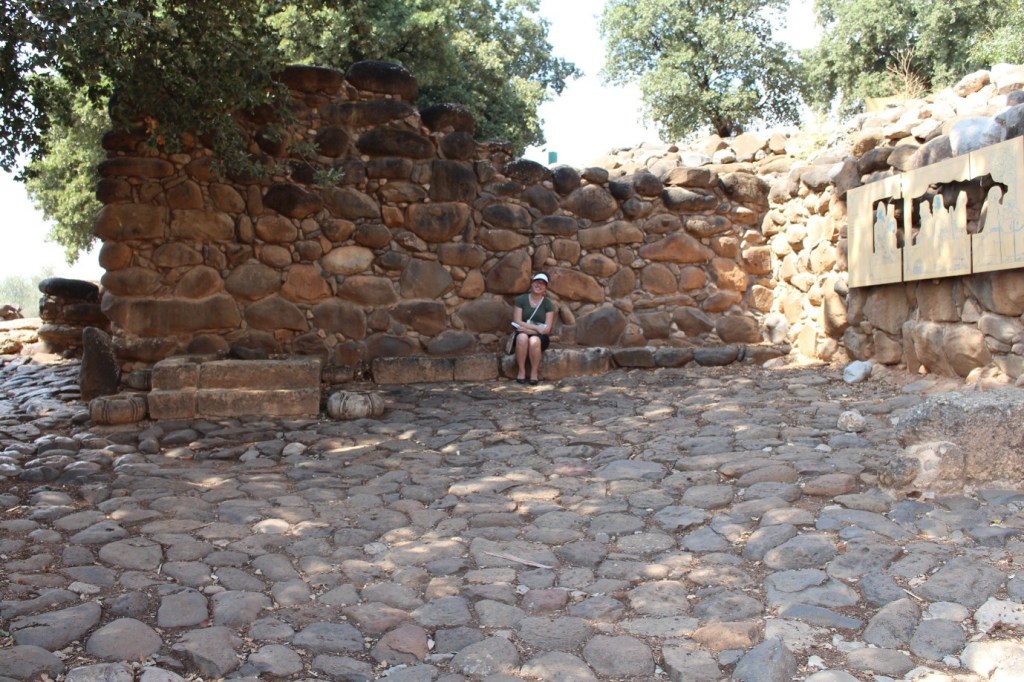
This was THE public place in the city – which is the point. Boaz will not solve a public matter with a private shortcut. He will not handle it by whispering, pressuring, insinuating, or doing a little arrangement in the dark. He will not bypass process just because he thinks he is right. He will not say, “Well, everyone knows how this ought to go, so let’s just make it happen.” No. He takes the issue where it belongs – before witnesses, before elders, before the community.
Boaz is not weak because he is transparent. He is strong enough to bring his case into the open. In a world, and sometimes in ecclesial life too, where people prefer private influence to public truth, Boaz is a rebuke[3]. Many of the ugliest things in communities are done under the banner of “wisdom” or “prudence,” when they are really just control without accountability. Boaz shows another way.
Chapter 3 asked whether Boaz and Ruth would act righteously when there was every opportunity not to. Chapter 4 asks whether Boaz will act righteously when process becomes inconvenient. Often people can be very moral in obvious temptations but far murkier in procedures, governance, and conflict. They will avoid scandalous sin, but they will bend truth, manipulate a meeting, stack a room, leak a rumour, or quietly define the outcome before anyone else has spoken. Boaz is righteous in both spaces: on the threshing floor and at the city gate. Private integrity and public integrity belong together.
John Doe – the man with no name
Then the nearer redeemer appears, and the narrator pointedly declines to name him. Boaz calls him, in effect, “so-and-so,” “Mr. So-and-So,” “John Doe.” That is not accidental[4]. In a book that has carefully named Naomi, Ruth, Boaz, Elimelech, Mahlon, Chilion, Perez, Obed, Jesse, and David, the man who stands in the way of redemption has no name. Or, to put it more sharply, the man who will not raise up the name of the dead loses his own in the narrative.
That does not necessarily mean he is some cartoon villain. In fact, one of the curious things of Ruth 4 is that the nearer redeemer is NOT presented as monstrously evil. He is not publicly spat upon. He is not ritually humiliated the way Deuteronomy 25 imagines for a recalcitrant brother in a levirate refusal. Ruth is not even present to shame him. He removes his sandal himself. He is allowed to step aside without theatrical disgrace because, in this case, there is a willing alternate. The book is subtler than simply telling us, “Here is a bad man and here is a good man.” It is showing us a more uncomfortable reality, there is a difference between ordinary, respectable self-protection and costly hesed.
Mr. So-and-So is what most of us would be tempted to call reasonable. He is cautious. He thinks in terms of inheritance, risk, household consequences, economic exposure, competing obligations. He is not outrageous he is just ordinary. And that is exactly the danger. Scripture warns not only about blatant wickedness but about respectable self-interest. We tend to only hear the warnings about the blatantly wicked. Yes great deal of harm is done by dramatic villains but also by decent people who draw the line at costly love.
That is one reason the contrast between Boaz and the unnamed redeemer is so powerful.
Orpah and the nearer redeemer each represent what is ordinary, understandable, even permissible and yet not hesed. Ruth and Boaz represent the extraordinary, the costly, the self-forgetful. The nearer redeemer is not condemned as some outrageous sinner. He is simply revealed as a man whose horizon stops at his own inheritance. Boaz’s horizon extends to Naomi, to Ruth, to the dead, to the family line, to the shape of Israelite life under God. That is a vast difference. Two individuals Orpah and the near kinsman vanish from the record, from history. Two others Ruth and Boaz advance the kingdom in a way they couldn’t foresee.
There is a warning here for us. It is possible to be respectable and still miss the heart of God. It is possible to do nothing technically scandalous and still fail the test of hesed. It is possible to be cautious, prudent, orderly, financially sensible, and yet spiritually small. The unnamed redeemer is a reminder that “not wrong” is not the same as righteous, and “permitted” is not the same as beautiful.
Naomi’s field and the complexity of the law (Ruth 4:3)
Boaz begins, somewhat surprisingly, not with Ruth but with Naomi’s land. At first glance that feels odd. After all, chapter 3 ended with Ruth’s bold appeal for marriage and redemption. Modern readers expect chapter 4 to open, “There is a widow to be married.” Instead it opens, “Naomi is selling the land.” But that is precisely the point. In the world of Ruth, land, name, inheritance, widow-care, and family continuity all belong together. The field is not a random side issue. It is the tangible form of the family’s threatened future.
Now, the legal detail here is not simple, and we do better to admit that than to pretend certainty. The Old Testament does not hand us a neat clause saying, “In a case exactly like Naomi’s, do x, y, z.” Commentators debate how Naomi had disposal rights over the land, what happened to it during the family’s years in Moab, whether someone else was using it, whether Naomi had inherited it outright or held it in trust, and how the custom precisely worked[5]. The JPS Tanakh Commentary summarises saying:
The suggestion that Naomi is entitled to land rights baffles some modern commentators, who question the plausibility that a widow would inherit her husband’s land in ancient Israel. Although several biblical texts indicate that women could own land (2 Kings 8:1–6), and inherit it (Numbers 27 and 36), no biblical text refers specifically to a situation comparable to that of Naomi and Ruth. However, extra-biblical Jewish sources from the fifth century b.c.e. document that women owned and were able to transfer property…(It is noteworthy that neither the unnamed redeemer nor Boaz is understood to be automatically entitled to the land, a detail that supports the assumption that the land does not revert to a male relative when there is a widow.)[6]
The ambiguity and lack of detail is not a defect in Ruth. It is part of the point. Biblical law often gives values and paradigms rather than an exhaustive modern-style manual. Real life then, as now, produced hard cases at the edge of categories.
That matters theologically. Ruth 4 is one of the places where we are reminded that the law of God is not merely a box of procedural rules to be mechanically applied. It is an expression of God’s values: care for the vulnerable, preservation of family inheritance, provision for widows, faithfulness to kin, protection of the weak, and the refusal to let death have the final word over a household. If we insist on making Ruth 4 fit some perfectly tidy legal scheme, we may miss what the book itself is doing. The characters are not abolishing God’s values. They are working hard to embody them in an unusual and painful case.
So why raise the field first? Because Boaz knows that this is the form the issue must take in public. The nearer redeemer cannot be asked abstractly whether he is a good man. He must be confronted with the concrete family crisis. Naomi has returned. The inheritance must be dealt with. The dead must not simply disappear into silence. The chapter is not about sentimental feelings; it is about what covenant faithfulness does when loss leaves real consequences in the world.
There is something pastoral here too. Sometimes hurting people do not need vague goodwill. They need someone wise enough to identify the actual issue that must be addressed. Boaz does not merely feel sorry for Naomi and Ruth. He sees the structural problem and moves on it. That is often the difference between compassion as emotion and compassion as redemption. A lot of people can say, “That is sad.” Far fewer can say, “This is the hinge point; this is what must now be done.”
Boaz’s two-step strategy, land then Ruth (Ruth 4:5-6)
Then comes one of the most interesting moments in the chapter. Boaz presents the land in a way that makes the arrangement appear attractive. The nearer redeemer says, in effect, “I will redeem it.” So far, so good. But then Boaz adds the crucial second piece in Ruth 4:5
When you acquire the field from Naomi, you must also acquire Ruth the Moabite, the wife of our deceased relative, in order to preserve his family name by raising up a descendant who will inherit his property
Suddenly the whole thing changes. Boaz will link the obligation of financial and family redemption together as Ruth did in Chapter 3 and when he does the near kinsman recoils. But what was Boaz doing to provoke this reaction? Was he being disingenuous?
There are several possible ways to explain the shift, and again certainty is elusive as Phillips notes:
our understanding of his dilemma is complicated by our lack of knowledge of the exact customs about family and community legal transactions, as well as by our ignorance of this man’s family and financial circumstances, one thing is clear. While gaining Naomi’s land would be to his advantage (or at least not to his detriment), gaining Ruth’s hand would complicate both his life and his bank account. Possibly it could mean that the inheritance he would be passing to his other children would be compromised[7]
Hubbard reviews various proposals and explanations of the legal position in detail before concluding that the nearer kinsman likely expected his only obligation would be the land and Naomi. As an older woman she was well past bearing children and might not live too long either. But Boaz inserts Ruth into the equation (not just Ruth but “the Moabitess”) and suddenly the maths changes[8].
Rather than being tricky, Boaz LIKE RUTH is applying the law as wisdom literature to achieve a just end. And the narrator is talking to us demonstrating this approach too.
Redeeming the land and financially supporting Naomi looks like prudent family kindness that might also increase one’s holdings. The second reveals that true redemption will be costly, because the inheritance will not stay with the man if an heir is raised up for the dead. The transaction changes from attractive generosity to genuine sacrifice.
The question becomes not, “Will you do the publicly admirable thing if it does not really cost you?” but, “Will you still do it when it threatens your own inheritance?” That is hesed.
That is a very searching question for modern believers. There is a kind of generosity that still serves self-interest. There is a kind of care that enhances one’s reputation, enlarges one’s network, soothes one’s conscience, or costs only surplus. There is a kind of righteousness that looks excellent right up to the point it becomes expensive. Chapter 4 exposes that difference.
James 1:27 comes very naturally here.
Pure and undefiled religion before God the Father is this: to care for orphans and widows in their misfortune and to keep oneself unstained by the world
“Pure religion” is not admiration for the vulnerable. It is care for them. And true care is not selective, it does not help only when the help can be structured to our benefit. Boaz is willing to accept precisely the version of obedience that may cost him land, money, simplicity, and perhaps public admiration. That is why he is a man of worth.
The sandal surrendered (Ruth 4:6-8)
Then comes the sandal. Modern readers often find this odd, but in the story it functions as a visible symbol of relinquishment and transfer. The narrator even pauses to explain that this used to be the custom in former Israel. That explanatory aside itself reminds us that the book’s final form comes from later than the events it narrates.
It is worth stressing that this is not simply the Deuteronomy 25 scene replayed[9]. In Deuteronomy, the brother who refuses the levirate duty is publicly shamed in a specific way. The rejected widow removes his sandal, spits in his face, and his house becomes known by the disgrace. That is not what happens here. The nearer redeemer is not Mahlon’s brother. Ruth is not present to shame him. No spitting occurs. The sandal is removed by the man himself and as Phillips notes there is a willing stand-in[10]. This is not the humiliation scene of Deut 25. It is a transfer scene.
Josephus in his retelling of this story claims the near kinsman was using Naomi’s field already but lost that right by refusing to take Ruth. Josephus states Ruth spat in Mr X’s face and took off his sandal in accordance with the law[11]. All of which is contrary Ruth 4 and should continue to give pause to relying on his accounts for anything much….
The likely symbolism of the sandal is tied to property rights. This imagery appears in Psalm 60:8, Deut 1:36 and Josh 1:3. It symbolised the right to walk your own land[12]. This was not a uniquely Israelite symbol:
[the] foot-placement motif is reflected in the Nuzi materials in which “to make a transfer of real estate more valid, a man would ‘lift up his foot from his property,’ and ‘placed the foot of the other man on it.’ ” With similar imagery, God declares possession of Edom with the metaphor of casting his sandal over the land (Ps 60:8; 108:9)[13]
Side note – this means Abraham was asked to demonstrate his faith by acting out on God’s promise in Gen 13:17
Get up and walk throughout the land, for I will give it to you
What colour was the sandal? We don’t know. But some were actually dyed….

An early Bronze age cuneiform tablet from Ur III recording the delivery of leather footwear which was frequently dyed with an imported green/blue pigment. The photo was taken by me in 2024 at the Harvard Museum of Ancient Near East photo 19 May 2024
Note in some commentaries there is detailed discussion in around the Hebrew grammar and who took off their shoe (Boaz or Mr X.) see Bush in particular who also debates the Nuzi texts[14]. However I think the balance of evidence points to Mr X surrendering his shoe.
In that there is a real earthiness, a reality of day to day living in ancient Israel. Rights and responsibilities were seen and simple. Righteousness ultimately becomes visible. Boaz took that shoe, put it on and wore it. For good. Hesed means a public commitment, a longterm commitment to doing the right thing regardless of the cost.
Ruth the Moabitess publicly names and received (Ruth 4:9-10)
One of the striking features of Boaz’s declaration is that he says it publicly:
I have also acquired Ruth the Moabite, the wife of Mahlon, as my wife, to raise up a descendant who will inherit his property” (Ruth 4:10).
He does not mute Ruth’s foreignness or hide it behind a safer label. He names it openly: Ruth the Moabitess. That is deliberate. The narrator keeps reminding us where Ruth is from so that we feel how unusual her place in Israel really is.
That tension matters because Deuteronomy 23:3 excluded Moabites from the assembly of Israel. Later rabbinic interpreters, clearly aware of Ruth, tried to limit the ban to Moabite males, but that is almost certainly a later attempt to resolve the difficulty (and resolve it poorly per the JPS Commentary[15]). The problem is real enough. The book does not solve it by pretending Ruth’s foreignness is irrelevant. It overcomes it. Ruth is not merely tolerated on the edge of Israel’s life; she is brought into the line of David. That is one of the book’s central shocks which sits uneasily alongside Deut 23 (and Ezra and Nehemiah for that matter!).
Boaz’s action therefore goes beyond benevolence. He does not keep Ruth in the category of beneficiary. He publicly binds himself to her, to her future, her vulnerability, and the social cost of identifying with her. There is a great difference between helping someone from a safe distance and standing beside them in full view. Boaz does not say, “I wish her well.” He says, in effect, “I am with her.”
That presses hard on any church or community content with warm feelings toward the needy or even one which provides for their financial needs. More is required. Honour, protection, voice, and belonging matter as well. It is easy to admire widows, migrants, the lonely, and the overlooked in theory. It is harder to make room for them as part of “us.” Boaz does the harder thing.
This also guards against reducing Ruth to a sentimental romance. There may well be affection here, but the chapter’s emphasis lies elsewhere. Duty, hesed, inheritance, public faithfulness, Naomi’s restoration, and God’s providential purpose are central. The marriage is personal, but it is not merely private. Ruth is not a Hallmark story, it is a redemptive, covenantal, kingdom-shaped narrative.
The blessing of the elders: redeeming the past (Ruth 4:11-12)
Once the transaction is settled, the elders and the people bless Boaz. They invoke Rachel and Leah, the women who built the house of Israel. Then they invoke Tamar and Perez. That second part is astonishing. It means the community does not hide the awkward past of Judah’s line. They do not pretend Genesis 38 never happened. They call it to mind right here at the moment of public blessing.
That is one of the best things in the chapter. God does not redeem by editing the family tree until it looks respectable. No whitewash is applied. He redeems the family tree by writing through it. Tamar’s story was messy, painful, morally tangled, and born out of male failure and family injustice. Moab’s origins are messy too. And yet here, in Ruth 4, the line of Judah and the line of Moab meet again — not in the ugliness of Genesis 19 or Genesis 38, but in a scene of public righteousness, integrity, and covenant faithfulness. The past is not denied. It is redeemed.
That has deep pastoral force. Many people live under the shadow of family stories they did not choose: scandal, addiction, abuse, fracture, betrayal, sexual mess, generational foolishness, inherited shame. One of the lies such people easily believe is that the mess of the past has fixed the limits of the future. Ruth 4 says otherwise. God is capable of bringing a king out of a line with Tamar behind it and Moab in it. He does not need a stainless human record to achieve a holy purpose.
There is also something important in the fact that the elders speak of women as builders of the house. Rachel and Leah build. Tamar stands as precedent. Ruth will build. The book of Ruth is not anti-male, Boaz is one of Scripture’s most attractive male characters, but it is profoundly aware that God’s purposes in Israel are carried forward through women whose faithfulness, courage, and initiative refuse to let death have the final word. That is one reason the book feels so fresh. It is set in the period of the Judges, a time of chaos, brutality, tribal failure, sexual violence, everyone doing what is right in his own eyes. In this darkness Ruth shows another kind of strength. It shows covenant life not nationally but at the level of household faithfulness, where women and men together embody hesed.
In Judges, Bethlehem is entangled in horror and Benjamin in shame. In Ruth, Bethlehem becomes the place where Torah-shaped life can still be found, where a worthy man and a worthy woman act with honour, and where a future king’s line is quietly secured. Ruth offers an alternative vision of Israel: not carnage, not lust, not civil collapse, but hesed, justice, generosity, and public righteousness.
Your story and mine is being written not by our insecurities, not by our past or our context but by a God who shows endless hesed. By a God who redeems.
Marriage conception and a quiet miracle (Ruth 4:13)
After all the human action of chapters 1–4 — leaving, returning, gleaning, blessing, scheming, waiting, proposing, sitting, witnessing, transferring, declaring — the narrator suddenly and simply says that Boaz took Ruth, she became his wife, he went in to her, and Yahweh gave her conception. That is one of the very few places in the book where the narrator explicitly attributes an event to God. It matters enormously.
Why here? Because it keeps the theology of the book properly balanced. Ruth is not fatalistic. Human choices matter; in fact, the whole book is built out of them. Ruth chooses Naomi. Naomi chooses return. Ruth chooses to glean. Boaz chooses generosity. Naomi chooses initiative. Ruth chooses courage. Boaz chooses public righteousness. All of that matters. But none of it means human faithfulness can manufacture life. At the decisive moment, the narrator insists: God gave conception. Providence has always been in the background, but now it comes close enough to name.
That guards against two opposite errors. One is passivity: “God will sort everything out; I need do nothing.” Ruth is a devastating rebuttal of that idea. The other is functional Pelagianism: “If we make enough good choices and manage the process well enough, we can produce redemption.” No. We can prepare the place where life may come, but we cannot generate life. Only God gives conception literally here, but the point spreads wider. Only God gives new birth. Only God gives true renewal. Only God brings dead things to life.
That is why chapter 4 is both humbling and comforting. It humbles us because even the best human actors are not sovereign. Boaz is outstanding, but he is not the giver of life. Ruth is extraordinary, but she cannot by sheer courage create the future. Naomi is perceptive, but she cannot engineer joy. God gives. And it comforts us because redemption does not finally depend on the flawless execution of human plans. If it did, Naomi would have stayed empty, Ruth would have stayed marginal, and Boaz’s kindness would have remained merely admirable rather than effective. The whole story rests on the God who acts through ordinary faithfulness but is never limited to it.
A son has been born to Naomi Ruth 4:14-17
Then the townswomen speak. And when they do, the emotional centre of the book becomes unmistakable again. They bless Yahweh because Naomi has not been left without a redeemer today. They speak of future restoration and sustenance in old age. And finally they say, astonishingly in v17, “A son has been born to Naomi.” Not to Elimelech. Not primarily to Boaz and Ruth. To Naomi.
That is one of the clearest indications that the book’s deepest arc has always been Naomi’s. Ruth is absolutely central, but as the means of Naomi’s restoration. The story began with Naomi losing husband and sons. It ends with Naomi receiving life back into her lap. In between, Ruth’s hesed and Boaz’s hesed have been the human channels through which God reverses Naomi’s emptiness. Your material has consistently stressed that point, and chapter 4 vindicates it. This is not merely the marriage of Ruth. It is the redemption of Naomi.
Interestingly the women are speaking of Obed the child as being Naomi’s redeemer. Naomi is no longer bereft, no longer empty, no longer without a goel. The old woman who once said, “The Lord has brought me back empty,” now has women around her praising God and interpreting her life in a completely different key.
And then comes one of the most beautiful lines in the book: Ruth, your daughter-in-law, loves you, and she is better to you than seven sons. That is staggering in a patriarchal setting. Seven sons represents completeness, security, idealised family fullness. The women of Bethlehem look at Ruth the foreign widow, the outsider, the Moabitess and publicly say that her covenant love outweighs the most prized form of traditional family strength. That is the public recognition Ruth never demanded. The woman Naomi could not yet see as a blessing in chapter 1 is now openly declared beyond price.
There is deep encouragement here for both Naomi-types and Ruth-types.
For the Naomi-types, older, wounded, bitter, disappointed, perhaps theologically bruised, perhaps convinced life has narrowed beyond meaningful reversal Ruth 4 says that God is not finished just because explanation never came. Naomi is not given a lecture. She is given redemption. God answers her bitterness not by telling her the hidden logic of every sorrow but by placing life (different life but life none the less) back into her arms.
For the Ruth-types, faithful, costly, loyal, unrecognised, perhaps carrying someone whose pain leaves little room for gratitude Ruth 4 says that unseen hesed is not unseen forever. There are seasons when the Naomi in your life cannot recognise what you are. There are seasons when you may feel, “I have given everything and still the story calls me invisible.” But God has a way of bringing hidden faithfulness into public honour in his time. The gift Naomi could not name in chapter 1 becomes the woman the whole town celebrates in chapter 4.
Bridging death to David Ruth 4-18-22
And finally, the genealogy. At one level, some readers are tempted to skip it. That would be a mistake, especially if we didn’t appreciate what was happening. The genealogy is not an appendix tacked on as an afterthought. It is the final interpretive key. It follows a significant pattern. There are 10 generations in the list which is significant.
Yes there were 10 years of death in Moab but that’s too simple. This is back to the master storyteller working on a bigger canvas.
Twice in Genesis we have exactly 10 generations mentioned, in Genesis 5 and 11. There are multiple functions of genealogies in scripture and this receives plenty of attention in the literature (up to nine functions are claimed[16]). However in Genesis it’s clear the focus on genealogies is because:
the entire book highlights the existence of a unique line of ‘seed’ which will eventually become a royal dynasty[17]
I would argue that in Gen 5 and 11 there is a very specific additional purpose. God is “restarting” his purpose with Noah and then again with Abraham. There are ample echoes of plotlines which reinforce this idea (trouble in gardens, moving east, city building, reputation/name building).
So yes the book of Ruth starts with a family collapsing and ends up with a dynasty, it starts with near extinction and ends with continuity. But this story is bigger than Naomi.
The genealogy locates the whole story inside the great movement of God’s purpose. Adam, Noah, Abraham and now the purpose of God will leap forward again with another huge character – David.
This little dull section of names anchors the tiny story in a bigger reality. God does world-shaping work through apparently local, ordinary, marginal things. We wonder where God might be working in our life. Or perhaps we question what God could ever do with us. Without this genealogy that is a fair question. It would simply be a nice happy ever after story of some backwater minor characters which changed nothing. We expect history to be moved only by spectacular figures and obvious crises – that can negatively shape our perception of our worth to God. Ruth says otherwise. So too does a baby boy lying in a manager in Bethlehem a few more generations on.
So what does Ruth 4 ask of us?
It asks for public integrity.
Boaz does not solve a covenant problem with a private shortcut. He teaches us that righteous ends do not justify shady means. Communities rot when gossip, whispering, factional behaviour, and procedural manipulation become normal. Chapter 4 calls the people of God back into the light.
It asks for costly hesed rather than easy generosity.
The nearer redeemer is willing while the arrangement suits him. Boaz is willing when it costs him. That difference remains a searching diagnostic for every age. Many of us are prepared to be kind until kindness really hurts us. It might put at risk our inheritance or maybe our time, plans, money, status, emotional energy, control. Ruth 4 asks: what happens when obedience becomes expensive? Will we be a Boaz?
It asks us to change them into “us”.
Boaz does not merely help Ruth. He publicly receives her. In a world still full of lonely people, single women, migrants, the elderly and people who live on the margins of social ease, chapter 4 calls for more than benevolent sentiment. It calls for structures of honour, protection, and belonging. We need to go past distant generosity to offering inclusion.
It invites us understand God’s long game.
Naomi could not see chapter 4 while standing in chapter 1. Ruth could not see David while holding baby Obed. Yes God was there working in their lives but with a far longer bigger plan than they ever saw. It wasn’t a noisy or theatrical intervention. But God was guiding events. That remains one of the book’s great comforts. Providence often works in ways that look ordinary until enough time has passed for the pattern to emerge.
And in understanding God’s long game let’s also understand our part. This story is made up of many small humble things. Of poor women just working faithfully to get through. This is exactly how God moves all the stories towards the kingdom. We can wonder what the eternal God would ever want with us. Ruth is a practical demonstration that God works with the seeming irrelevant because no act of hesed is insignificant to him.
Conclusion
Ruth 4 is the chapter where redemption steps into the light. What began in famine ends in fullness. The story has taken us from disaster in Moab to joy in Bethlehem and, just for the readers, an understanding of hope for the nation of Israel.
The chapter and the whole story doesn’t cheat. It does not pretend the pain wasn’t real. The dead remain dead and the scars in Naomi’s heart remain. There is no pretty explanation for Naomi that makes light of her losses. Ruth is not turned into a Hallmark heroine, no cheap romance here. The book does something better, it shows how God answers emptiness through hesed, public righteousness, patient providence, and life given at last.
It’s a little book, set in a time of national chaos and wickedness. But it demonstrates how and where God works, and more importantly who he works with, then and now.
The kingdom of God does not move forward by conquest and loud trumpeting of good deeds. Sometimes it advances with the arrival of an impoverished bitter old woman and her foreign daughter in law.
Zechariah in Zech 4:10 tells the nation who were disappointed that things weren’t as grand as they wanted to not despite the day of small things. God’s purpose moves in the small things then and now.
What does he want from us? To continue. To maintain covenantal faithfulness until the greater son of David, son of Obed, son of Ruth arrives.
God is not unjust so as to forget your work and the love you have demonstrated for his name, in having served and continuing to serve the saints. But we passionately want each of you to demonstrate the same eagerness for the fulfilment of your hope until the end Hebrew 6:10-11
by Daniel Edgecombe
[1] Fredric W. Bush, Ruth, Esther, vol. 9, Word Biblical Commentary (Dallas: Word, Incorporated, 1996), 191.
[2] Jr. Campbell Edward F., Ruth: A New Translation with Introduction, Notes, and Commentary, vol. 7, Anchor Yale Bible (New Haven; London: Yale University Press, 2008), 110.
[3] Christopher A. Beetham and Nancy L. Erickson, eds., The NIV Application Commentary on the Bible, One-Volume Edition, NIV Application Commentary (Grand Rapids, MI: Zondervan Academic, 2024), 224
[4] “Surely such a pointed way of underscoring the namelessness of this man in a narrative that so carefully names the other protagonists (cf. 1:2, 4; 2:1) subtly creates a less than favorable impression of him and prompts us to suspect a pejorative purpose in the choice of the expression” Fredric W. Bush, Ruth, Esther, vol. 9, Word Biblical Commentary (Dallas: Word, Incorporated, 1996), 197.
[5] See extensive discussion in Robert L. Hubbard, The Book of Ruth, The New International Commentary on the Old Testament (Grand Rapids, MI: Wm. B. Eerdmans Publishing Co., 1988), 52–56
[6] Tamara Cohn Eskenazi and Tikva Frymer-Kensky, The JPS Bible Commentary: Ruth, First edition, JPS Tanakh Commentary (Philadelphia, PA: Jewish Publication Society, 2011), 73.
[7] W. Gary Philips, Judges, Ruth, ed. Max Anders, vol. 5, Holman Old Testament Commentary (Nashville, TN: Holman Reference, 2004), 348.
[8] [Hubbard particularly demolishes in my view the suggestion of a textual quick whereby Boaz actually states he will marry Ruth separate to the deal and thereby imperil Mr. X’s investment by potentially creating an heir – a suggestion found in Tamara Cohn Eskenazi and Tikva Frymer-Kensky, The JPS Bible Commentary: Ruth, First edition, JPS Tanakh Commentary (Philadelphia, PA: Jewish Publication Society, 2011), 78among others] Robert L. Hubbard, The Book of Ruth, The New International Commentary on the Old Testament (Grand Rapids, MI: Wm. B. Eerdmans Publishing Co., 1988), 56–62
[9] James McKeown, Ruth, ed. J. Gordon McConville and Craig Bartholomew, The Two Horizons Old Testament Commentary (Grand Rapids, MI; Cambridge, U.K.: William B. Eerdmans Publishing Company, 2015), 90–91
[10] W. Gary Philips, Judges, Ruth, ed. Max Anders, vol. 5, Holman Old Testament Commentary (Nashville, TN: Holman Reference, 2004), 357–358
[11] Flavius Josephus and William Whiston, The Works of Josephus: Complete and Unabridged (Peabody: Hendrickson, 1987), 149.
[12] W. Gary Philips, Judges, Ruth, ed. Max Anders, vol. 5, Holman Old Testament Commentary (Nashville, TN: Holman Reference, 2004), 349.
[13] Craig S. Keener and John H. Walton, eds., NIV Cultural Backgrounds Study Bible: Bringing to Life the Ancient World of Scripture (Grand Rapids, MI: Zondervan, 2016), 456.
[14] Fredric W. Bush, Ruth, Esther, vol. 9, Word Biblical Commentary (Dallas: Word, Incorporated, 1996), 234
[15] “With Ruth in mind, the Rabbinic sages interpreted the passage as applying solely to males (see Ruth R. 2.9), which is a problematic solution given that the singular “Moabite” often serves as a collective noun referring to an entire people, as does Israel. In B. Yev. 77a an additional explanation is offered: because the exclusion results from the Moabites’ refusal to welcome the Israelites with bread and water, it must refer to the men only; no one would have expected Moabite women to bring bread and water. But some Rabbinic sources acknowledge that this ingenious interpretation is likely to be a late innovation. So, for example, in Pesikta de-Rav Kahana, Boaz assures Ruth that she is fortunate to have come when she did, because the halakhah only recently determined that the Deuteronomic ban refers only to Moabite men (PdRK, Nachamu 16.1). Despite this later Rabbinic view, it is almost certainly the case that Deuteronomy 23 excludes from community membership the children of a union between Israelites and Ammonites or Moabites. This law bears directly on the status of the descendants of Boaz and Ruth, on David’s status in particular.” Tamara Cohn Eskenazi and Tikva Frymer-Kensky, The JPS Bible Commentary: Ruth, First edition, JPS Tanakh Commentary (Philadelphia, PA: Jewish Publication Society, 2011), xlvii.
[16] David A. Hubbard et al., “Editorial Preface,” in 1 Chronicles, vol. 14, Word Biblical Commentary (Dallas: Word, Incorporated, 1986), 3.
[17] D. T. Alexander, “Genealogies, Seed and the Compositional Unity of Genesis,” Tyndale Bulletin 44, no. 2 (1993): 269.

